How to visit Tiger Park Phuket
Tiger Park Phuket is an interactive wildlife park best known for its supervised tiger encounters, from tiny cubs to full-grown adults. This is not a full-day zoo visit — it’s a short, tightly managed experience built around 10-minute sessions, photo time, and a few walk-around extras. Your visit goes much better when you choose the right tiger category and avoid the late-morning rush. This guide covers timing, tickets, layout, and the rules that matter once you’re there.
Quick overview: Tiger Park Phuket at a glance
- When to visit: Daily, 9am–6pm. The quietest window is usually 9am–10:30am, which feels much calmer than 11am–2pm when Big Buddha stopovers, tours, and cub demand all stack up at once.
- Getting in: From $9 for standard walk-around entry. Tiger encounters start from about $27, and booking ahead matters most for newborn, white tiger, and weekend slots.
- How long to allow: 2–3 hours works for most visitors. It stretches toward 3 hours if you book more than one tiger category, linger for photos, or stop at the café and canopy walk.
- What most people miss: The canopy walk and the café viewpoint are easy to skip, even though both give you a calmer way to see the tigers outside the fast-paced photo sessions.
- Is a guide worth it? A full guide usually isn’t necessary because every enclosure session already comes with a handler, but transfer-inclusive packages help if you don’t want to deal with Phuket taxi logistics.
🎟️ The first newborn and white tiger slots on weekends and school-holiday dates can sell out in advance. Lock in your visit before the time you want is gone.
Jump to what you need
🕒 Where and when to go
🗓️ How much time do you need?
🎟️ Which ticket is right for you?
🗺️ Getting around
🐯 Which animals to prioritise
♿ Facilities and accessibility
Where and when to go
How do you get to Tiger Park Phuket?
Address: Moo 10 Soi Yot Sane 1, Chalong, Phuket, Thailand
- Taxi / rideshare: Use ‘Tiger Park Phuket’ as your drop-off point → direct to reception → easiest option from Patong, Kata, Karon, or Phuket Town.
- Car / scooter: Road access runs up the Big Buddha hill approach → on-site parking is available → the easiest choice if you’re pairing the visit with Big Buddha or Wat Chalong.
- Private transfer: Best for hotel pickups and same-day tours → check whether Chalong, Patong, or Kata is included before booking.
Which entrance should you use?
There’s one main public entrance, but once you check in, queues split by ticket type and tiger category — and that’s where most visitors lose time.
- Pre-booked encounters: For timed tiger sessions. Expect around 5–15 minutes of waiting on quieter weekdays.
- Walk-in tickets and upgrades: For same-day buyers or people changing tiger categories. Expect the longest waits in late morning and on weekends.
- Walk-around admission: For visitors not entering an enclosure. This is usually the fastest line unless cub sessions are creating congestion at reception.
When is Tiger Park Phuket open?
- Monday–Sunday: 9am–6pm
- Last entry: Plan to arrive by 5pm if you want more than a quick walk-through or a final tiger session.
When is it busiest? The park is busiest from 11am–2pm, on weekends, and during November–March, when Phuket day tours and Big Buddha visits overlap and cub queues build quickly.
When should you actually go? Aim for 9am–10:30am if you want shorter waits, cooler temperatures, and a better shot at the most in-demand cub categories before the park feels crowded.
How much time do you need?
| Visit type | Route | Duration | Duration | What you get |
|---|---|---|---|---|
Highlights only | Entrance → 1 tiger zone → photo area → exit | 45–60 mins | 0.5 km | Best if you only want one tiger interaction and a few photos. Fast and easy, but you’ll skip the larger tiger categories and viewing paths. |
Balanced visit | Entrance → small/medium tiger zones → canopy walk → café → exit | 1.5–2 hrs | 1 km | Covers the most popular interaction zones with enough time for photos and breaks. This is the sweet spot for most visitors. |
Full exploration | Entrance → multiple tiger categories → viewing paths → canopy walk → café → exit | 2.5–3 hrs | 1.5 km | Lets you experience different tiger sizes, photo setups, and walkways without rushing. Worth it if you booked combo interactions, though the repeated waiting and heat can feel tiring by the end. |
Which Tiger Park Phuket ticket is best for you
| Ticket type | What's included | Best for | Price range |
|---|---|---|---|
Tiger interaction ticket | Entry to Tiger Park Phuket with one 10-minute tiger interaction session. Choose from newborn, smallest, small, medium, big, or white tiger categories. | A short wildlife stop where you mainly want photos and one close-up interaction without spending half a day inside. | From ฿457 |
Tiger play package | Multiple tiger interaction sessions across 2, 3, or all 4 tiger sizes, with supervised enclosure access and more photo opportunities. | Visitors who want to compare different tiger sizes and turn the visit into a longer, more complete experience rather than a quick stop. | From ฿2,400 |
Lion Land Phuket ticket | Entry to Lion Land Phuket with a scheduled 15-minute lion interaction session in your selected category. | Adding another controlled big-cat encounter nearby without committing to a full combo attraction day. | From ฿2,400 |
Phuket Elephant Sanctuary + Lion Land combo | Guided elephant sanctuary visit with feeding interaction, plus a scheduled lion encounter at Lion Land Phuket. | A wildlife-focused day where you want a broader animal experience instead of only tiger or lion photos. | From ฿810 |
Carnival Magic + Lion Land combo | Evening entry to Carnival Magic with parade/show access, combined with a Lion Land interaction session. | Splitting your day between a daytime animal encounter and a large-scale Phuket night attraction without booking separately. | From ฿1,482 |
How do you get around Tiger Park Phuket?
Tiger Park works as a zone-based animal park with separate encounter areas for newborn, smallest, small, medium, big, and white tigers, plus viewing paths, a canopy walk, and a café. You can cover the highlights in about 2 hours, but 3 hours feels better if you book more than one tiger category.
How is the park laid out?
- Newborn & smallest tiger zones: High-demand cub encounters and photos → allow 15–20 mins.
- Small & medium tiger zones: Most balanced interaction experience → allow 15–20 mins each.
- Big & white tiger zones: Most dramatic photo encounters → allow 15–20 mins each.
- Canopy walk & viewing paths: Extra elevated and enclosure views → allow 20–30 mins.
- Café & seating area: Good final break stop → allow 20–30 mins if dining.
Suggested route: Start with your timed encounter first, then walk the other tiger zones while you’re already oriented, save the canopy path for after the busiest reception period, and finish at the café instead of doubling back toward the entrance.
Maps and navigation tools
- Map: The park is compact enough to navigate on foot → ask reception to point out your booked zone order before you start.
- Signage: Main wayfinding is good for public paths, but reception is still the best place to confirm where your exact tiger category checks in.
- Audio guide / app: There isn’t a known park audioguide → the handlers do the practical explaining, so most visitors won’t miss one.
💡 Pro tip: Ask staff to group your booked tiger sessions in a sensible order before you head in — otherwise it’s easy to zigzag between zones and waste 15–20 minutes between call times.
Get the Tiger Park Phuket map / audio guide
Which animals and habitats should you prioritise?

Newborn cubs
Attribute — Species: Bengal tiger cubs
These are the park’s most in-demand encounters, and they’re the main reason many families book ahead instead of showing up. The appeal is obvious — they’re tiny, fluffy, and far more active than most people expect. What visitors often miss is how short the window is for this category; availability can change faster than the bigger tiger sessions.
Where to find it: In the newborn tiger zone near the front-end encounter check-in areas.
Small tigers
Attribute — Species: Juvenile Bengal tigers
Small tigers give you the sweet spot between cub cuteness and a more substantial tiger encounter. They still feel playful and photo-friendly, but they’re usually calmer than the youngest cubs. What people rush past is how good this category is for mixed-age groups — it often feels less intimidating than adults and less chaotic than newborns.
Where to find it: In the small tiger enclosure zone after the youngest cub sections.
Medium tigers
Attribute — Species: Adolescent Bengal tigers
Medium tigers are easy to overlook because most visitors book either the tiniest cubs or the biggest cats, but this category often gives you the most balanced session. They’re large enough to feel impressive while still reading clearly in photos and group shots. Most people miss them because they sound like a compromise, when they’re often the most manageable encounter.
Where to find it: In the medium tiger zone between the small and adult sections.
Big tigers
Attribute — Species: Adult Bengal tigers
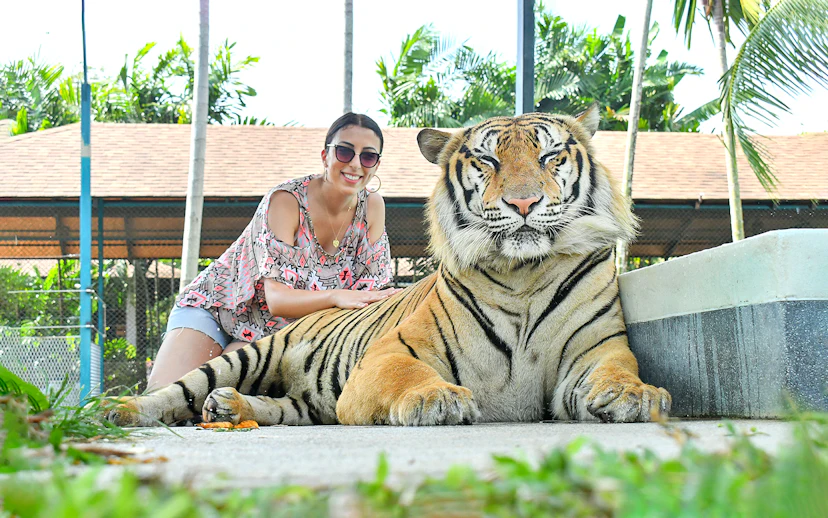
This is the park’s adrenaline category, and it’s the encounter most likely to leave you genuinely humbled by the animal’s size. The experience is tightly controlled, with handlers guiding where you sit and how close you move. What people often don’t realize until they’re inside is how still you need to stay for the best photos and the smoothest session.
Where to find it: In the large adult tiger enclosures toward the farther end of the encounter route.
White tigers
Attribute — Species: White Bengal tigers
The white tigers are the most visually distinct animals in the park, and they tend to attract visitors who want something rarer than the standard orange-and-black encounter. Their pale coat photographs especially well in softer morning light. Many visitors skip this category because they assume it’s just a color variation, but it feels more memorable in person than it does on the booking page.
Where to find it: In the separate white tiger enclosure area, apart from the standard Bengal tiger zones.
Canopy Forest Safari
Attribute — Habitat viewpoint: Elevated park and enclosure views
This isn’t another animal encounter, but it’s the part of the visit that gives your day some breathing room after the tightly timed photo sessions. You get a different perspective over the grounds and a calmer way to watch the animals from above. Most people miss it because they leave right after their tiger slot instead of treating the park as more than a 10-minute stop.
Where to find it: Along the elevated walkway and viewing area above the main enclosure paths.
Facilities and accessibility
- 🎒 Bag handling: Keep what you carry light, because you’ll want both hands free during enclosure sessions and loose items are inconvenient around the animals.
- 🚻 Restrooms: Restrooms are available in the public park areas, where they’re easiest to use before or after your tiger session rather than mid-queue.
- 🍽️ Café / restaurant: There’s an on-site café and restaurant overlooking a tiger enclosure, and it works best as a post-session break more than a destination meal.
- 🛍️ Gift shop / merchandise: A souvenir stop is built into the visitor flow near the exit, which is the easiest time to buy prints or tiger-themed keepsakes.
- 🪑 Seating / rest areas: Seating is available around the café and public waiting areas, which matters if you’re stacking more than one encounter.
- 🅿️ Parking: On-site parking is available and makes the visit much easier if you’re driving between Big Buddha, Wat Chalong, and Chalong itself.
- ♿ Mobility: Public areas are wheelchair accessible, but some tiger enclosures involve steps, crouching, or close positioning that can make the full experience only partly accessible.
- 👁️ Visual impairments: Staff-led handling instructions are the main support on-site, so tell reception what you need before your session starts.
- 🧠 Cognitive and sensory needs: The easiest low-stress window is early morning, because reception is calmer and the enclosure areas feel less noisy than late morning.
- 👨👩👧 Families and strollers: Strollers work better in the public paths than inside the encounter flow, and younger children are limited to the smallest or newborn tiger categories.
This works best for children who are excited by animals and can follow instructions calmly, because the visit is short, supervised, and built around controlled photo moments rather than free play.
- 🕐 Time: 2 hours is realistic with young children if you focus on one tiger category and skip trying to do every enclosure.
- 🏠 Facilities: The café seating and public waiting areas make it easier to pause between sessions, especially if your child needs a break after the first encounter.
- 💡 Engagement: Book the smallest or newborn category first, because that is usually the part children connect with most and it avoids saving the highlight for the tired end of the visit.
- 🎒 Logistics: Bring water for before and after the session, keep clothes simple, and avoid overpacking because you’ll move through the park more smoothly with less in hand.
- 📍 After your visit: Big Buddha is the easiest nearby follow-up if your child still has energy and you want one more quick stop without a long transfer.
Rules and restrictions
What you need to know before you go
- Timed encounter tickets work best because your session is tied to a specific tiger category and late arrivals can mean waiting for the next available slot.
- Children under 2 may enter free, but younger visitors are limited to the newborn or smallest tiger categories and must be accompanied by an adult.
- Visitors under about 15 years old or shorter than 160 cm are generally restricted to the youngest tiger zones rather than the adult enclosures.
- Plan the visit as one continuous stop, because your waiver, queue position, and tiger session flow are all handled at reception.
Not allowed
- 🚫 Food and drink are best kept out of the animal areas, so eat before or after your session rather than carrying snacks into the encounter flow.
- 🚬 Smoking and vaping should stay out of the animal and queue areas.
- 🐾 Pets are not part of the park experience, though service-animal questions are best cleared with staff before arrival.
- 🖐️ Touch only as instructed by the handlers, because where you stand and place your hands is tightly controlled for safety.
Photography
Phone and camera photos are one of the main reasons people come, and handlers can usually help take shots during your session. Flash should stay off around the animals, and the practical line is simple: if a device or movement could distract the tiger or get in the handler’s way, it won’t belong inside the enclosure. Professional photo services are available separately if you want more polished images.
Good to know
- Newborn and white tiger sessions are the categories most likely to fill first, so don’t assume the exact tiger size you want will still be available if you arrive late.
- This is a close-contact wildlife attraction, so if you’re uncomfortable with captive-animal encounters on ethical grounds, it’s better to decide that before booking rather than on arrival.
Practical tips
- Booking and arrival: Book ahead for newborn, white tiger, or weekend sessions, and arrive 20–30 minutes early so the waiver and check-in don’t eat into your best photo window.
- Pacing: Put your highest-priority tiger category first, because once you’ve done the main encounter the rest of the park feels like a bonus rather than a rushed checklist.
- Crowd management: The best working slot is usually 9am–10:30am, when reception is calmer, the heat is lower, and you’re not competing yet with Big Buddha traffic.
- What to bring or leave behind: Bring a fully charged phone with storage cleared, because handlers often take photos for you and you’ll get more out of the visit if you don’t fumble with apps and backups on the spot.
- Clothing: Wear simple, neutral clothes and skip anything loose or awkward, because the big tiger sessions are easier when you can move calmly and kneel or sit without adjusting your outfit.
- Food and drink: Save the café for after your final session, because eating first can break your momentum and food isn’t part of the enclosure flow anyway.
- Expectations: If you only book one 10-minute session, treat the walk-around paths and canopy area as part of the value, otherwise the day can feel shorter than the ticket page makes it sound.
- Families: Younger children usually do best with the smallest or newborn category, and trying to stretch them through multiple tiger sizes often adds cost more than enjoyment.
What else is worth visiting nearby?
Commonly Paired: Big Buddha
Distance: 300m — around 5 minutes on foot or a very short drive
Why people combine them: The park sits directly below the hill, so this is the easiest same-day pairing in the area and barely adds transfer time.
Commonly Paired: Wat Chalong
Distance: A short drive from Chalong — about 10–15 minutes by road
Why people combine them: It balances the park’s tightly managed animal encounter with a calmer cultural stop and fits naturally into a Chalong half-day route.
Also nearby
- Phuket Bird Park — About 15 mins away by car; an easy walk-around animal attraction after the tiger sessions.
- Chalong Pier — About 5–10 mins away by taxi; convenient if you’re staying in Chalong or heading for a boat tour later.
Eat, shop and stay near Tiger Park Phuket
- On-site: The park café and restaurant serves Thai food and drinks in a mid-range setting, and it’s worth it more for the tiger-view table than for making this your main Phuket meal.
- Big Buddha hillside cafés: 5–10 minutes away on Nakkerd Hill road, and best for a quick coffee or cold drink if you’re already pairing the park with the viewpoint.
- Wat Chalong area restaurants: 10–15 minutes away around Chao Fah Road, and better for a fuller Thai lunch once you’re done with timed sessions and want more choice.
- Chalong area eateries: 10–15 minutes away, and a smarter post-visit option if value matters more than convenience and you don’t need the novelty of eating beside an enclosure.
- 💡 Pro tip: Eat after your final tiger session, not before — it keeps your timing cleaner and lets you use the café view as a wind-down rather than wasting your best slot at a table.
- Tiger Park gift shop: Tiger-themed souvenirs and quick keepsakes are easiest to pick up near the exit after you’ve finished every session.
- On-site photo counter: Check your encounter photos before leaving, because this is the simplest place to decide whether the professional shots are worth buying.
Chalong is practical if your Phuket plan already includes Big Buddha, Wat Chalong, dive departures, or a few inland sights. It is not the island’s best base if you want to spend most of your time on the beach or walk out to nightlife. For a short, logistics-heavy stay, though, it’s efficient.
- Price point: Chalong usually skews more moderate than the beach resort zones, with better value if you care about transport convenience more than sea views.
- Best for: Travelers on a short Phuket trip who want easy access to Big Buddha, Wat Chalong, and south-island day trips without crossing the island every time.
- Consider instead: Kata or Karon if you want beach time built into every day, or Patong if nightlife matters more than staying close to inland attractions.
Frequently asked questions about visiting Tiger Park Phuket
Most visits take 2–3 hours. A single tiger interaction lasts about 10 minutes, but check-in, waivers, briefing, waiting time, photos, and walking the rest of the park add up quickly. If you book more than one tiger category or stop at the café, you’ll be closer to the 3-hour mark.
Yes, it’s smart to book in advance if you want a specific tiger category or a morning slot. Newborn, white tiger, and weekend sessions are the first to tighten up, while simple walk-around admission is easier to buy same day. Booking ahead matters more for timing than for sheer entry.
Yes, it can be worth it on busy late mornings and weekends when reception lines slow down the start of your session. The value is mostly in protecting your preferred time slot rather than saving huge amounts of time inside the park. If you’re arriving early on a weekday, the benefit is smaller.
Arrive 20–30 minutes early. That gives you enough buffer for check-in, the waiver, and staff instructions without starting your visit already rushed. If you arrive right on time, you may still get in, but the flow feels tighter and you lose flexibility if reception is busy.
Yes, but keep it small and easy to manage. You’ll want free hands during the encounter, and the park works more smoothly when you’re not juggling extra items near the enclosures. A light crossbody or small day bag is much easier than a bulky backpack.
Yes, photos are a core part of the experience. Handlers can usually help take shots with your phone or camera during the session, and professional photos are sold separately. Keep flash off, follow staff positioning instructions, and expect the enclosure team to control how the photo moment works.
Yes, groups can visit, and the park is set up to move families, couples, and small tour groups through scheduled encounters. The main trade-off is time: larger groups often spend more of the visit waiting for each person’s turn inside a zone. If you want a smoother flow, book early and keep expectations realistic.
Yes, it can work well for families, especially if you choose the smallest or newborn tiger categories. Children under about 15 years old or shorter than 160 cm are generally limited to the youngest tiger zones, so don’t plan on an adult-tiger session for every child in the group.
Partly. The public areas, paths, and café are accessible, but some encounter spaces involve steps, crouching, or tight positioning that can make the full experience difficult. If accessibility is important for your visit, the safest approach is to confirm your preferred tiger category at reception before you commit.
Yes, there’s an on-site café and restaurant, and there are more dining options in Chalong a short drive away. The on-site spot is best as a convenient break after your session, especially for the enclosure view. If food quality or value matters more, eat in Chalong after the park.
You can usually choose from newborn, smallest, small, medium, big, and white tiger categories. The youngest cubs and the rare white tigers are often the most in-demand, so availability can be tighter than the standard orange tiger sessions. Your best move is to book the exact category you care about instead of deciding on arrival.
Yes, you can visit on a walk-around ticket without entering an enclosure. That works if you want to see the grounds, café, and viewing areas but don’t want the close-contact part of the attraction. It’s also the better option if you’re still undecided about the experience once you get there.